si sapsford

Drawing
Painting and drawing remain central to Sapsford’s practice, from large-scale biro works and portraiture to psychologically charged figurative paintings. These works explore identity, memory, vulnerability, and art-historical reference.
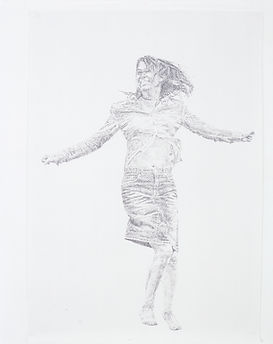
Developed alongside her mechanical works, Si Sapsford’s large-scale biro drawings offer a parallel exploration of vulnerability, identity, embodiment, and psychological tension. While the kinetic sculptures externalise conflict through movement and mechanical confrontation, the drawings hold tension in stillness. Bodies appear suspended, exposed, withdrawn, or caught in moments of emotional and psychological intensity. Working in biro—a medium associated with immediacy and everyday use—Sapsford transforms simple mark-making into highly detailed, monumental works. Drawing on self-portraiture, portraiture, performance, and art historical reference, these works explore the body as a site of memory, belief, projection, and transformation. A recurring feature is the refusal of direct gaze. Subjects frequently appear with eyes closed, turned away, or psychologically withdrawn, resisting conventional portraiture and creating tension between exposure and inaccessibility.
Doubting Thomas
Doubting Thomas 2002 — Jerwood Drawing Prize Exhibition Catalogue, Jerwood Space, London, UK

Faisal
This portrait captures Faisal Abdu'Allah at a moment of spiritual transformation following his conversion from Christianity to Islam. With eyes closed and attention turned inward, the drawing resists traditional portraiture, focusing instead on introspection, belief, and psychological transition.


St. Sebastion
This Drawing is inspired by the photograph of Mohammed Ali protesting against the Vietnam war
Companion piece to the painting Last Orders, this work was drawn in pencil on 12 panels


Ascension
This life size self portrait shows a runner, face distorted through movement
Ring
This drawing of a life ring was exhibited in Zurich. The work was transported in a small carry on bag and was crumpled to fit in, creating the textured surface which offers a feeling of movement

Fay Wray
Fay Wray (after King Kong) Referencing cinema and performance, this life-size self-portrait draws on the iconic image of Fay Wray in King Kong. The work explores feminine vulnerability, spectacle, and fear, while questioning the cultural roles imposed on women within visual narratives.

Wax Crayon Drawings
Large Scale Wax Crayon Drawings

Wax Crayon Drawing 1

Wax crayon Drawing 2

Wax Crayon drawing 3