si sapsford
Civil Unrest
“I want ‘civil unrest’ to sit uncomfortably with the viewer. I think of it in quite a traumatic way because what we might think of as filmic is actually happening in reality in real time. Whilst we might stand or sit or drink a double espresso, on the other side of the globe there are people being water boarded. There is somebody trying to climb a fence trying to hand their child over to safety.”
Trinity Buoy Wharf, London (2015)
Suspended between domestic familiarity and political violence, Civil Unrest asks how much pressure a structure—physical, social, or psychological—can endure before collapse.
Exhibited in London during a period marked by public protest and growing political division, Civil Unrest echoed wider debates about inequality, migration and national identity. The installation followed the Occupy movement outside St Paul's Cathedral, where demonstrators challenged the concentration of wealth and economic power, while discussions surrounding migration increasingly framed difference through fear and suspicion.
Against this backdrop, the repeated advance of the chairs suggested an encounter between those seeking belonging and those resisting change. The work does not ask viewers to choose sides; instead, it explores the uncertainty that exists whenever people confront what they do not yet understand.
Change Makers: Ways of Protest, Elysium Gallery, Swansea (2020)
Presented within an exhibition examining protest and social change, Civil Unrest connected with Swansea's own history of industrial struggle. The closure of the South Wales mines left lasting economic and social consequences for many communities, while the miners' strikes remain powerful symbols of collective resistance and political conflict.
Within this context, the sculpture became a meditation on the legacy of protest. The repetitive movement of the chairs reflected both confrontation and perseverance, acknowledging that social change is rarely immediate and often comes at considerable personal cost. Rather than commemorating a single historical event, the work invited reflection on the continuing relationship between protest, community and hope.
Elastic Bands
The elastic bands, often barely visible, are central to the work. They hold the structure in a state of stored tension, simultaneously restraining movement and enabling it.
This unstable equilibrium becomes a metaphor for wider social and political pressures: systems stretched to breaking point, held together until a tipping point is reached.
Mother Art Prize 2023
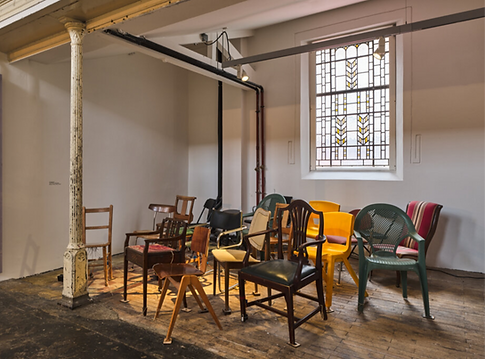
Shown as part of the Mother Art Prize, Civil Unrest acquired a more personal dimension. The exhibition foregrounded the experiences of women balancing artistic practice with the responsibilities of work, caregiving and family life. Within this context, the sculpture could be understood less as a public demonstration than as a reflection on the quieter forms of struggle that often remain unseen.
The repeated movement of the chairs suggested persistence rather than resolution, echoing the continual negotiation between creative ambition, domestic responsibility and personal identity. Here, civil unrest existed not only within society but also within everyday life, where competing demands and expectations are navigated through resilience and determination.
Domestic Affairs, Rio de Janeiro, Brazil (2011)
Installed in the commercial district of Rio de Janeiro, Civil Unrest took on a particular resonance within a city marked by sharp economic divisions. The chairs used in the installation were sourced from the favelas, where they had reached the end of their useful lives before being repaired and incorporated into the work. Returning these everyday objects to a gallery situated within one of Rio's wealthier districts created a quiet dialogue between different social worlds.


Using domestic chairs held in precarious balance by stretched elastic tension, the work transforms familiar furniture into a psychologically charged field of instability. Rocking, colliding, and repeatedly returning to motion, the chairs evoke conflict, pursuit, resistance, and survival.
Here the advancing chairs suggested not only confrontation but also the invisible boundaries that separate communities. The work became a reflection on inequality, displacement and the ways in which people are too often defined by where they come from rather than who they are.